Author: Brian

  • Nematode Resistance Progress Report

    Nematode Resistance Progress Report

    Photos by Kevser Ozel, University of Wisconsin

    Breeding efforts seem to be paying off as researchers are seeing more and more carrots showing resistance to root-knot nematodes.

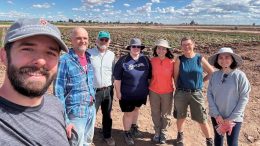
    Carrots were put to the test in a recent trial that included a large collection of open-pollinated carrots from the USDA germplasm collection, along with breeding materials from the University of Wisconsin’s program and the seed industry. The trial evaluated the selections for root-knot nematode resistance in the field with the objective of identifying resistant carrot genotypes for future breeding efforts and genetic research.

    The annual trial has been ongoing for several decades at California locations including Coachella, Kearney and Irvine. This year’s trial took place at the University of California – Riverside Coachella Valley Agricultural Research Center. There, Phil Roberts and Bill Matthews maintain a root-knot nematode-inoculated field by growing crops that are susceptible to root-knot nematodes, which helps keep a high and fairly uniform nematode population in the field. The University of California-Riverside team then grew carrot breeding material that the seed industry chose to be evaluated for root-knot nematode resistance.

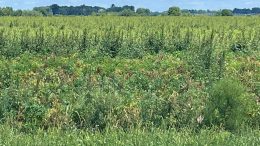
    A field trial evaluates carrots resistant to root-knot nematodes (top) and susceptible to root-knot nematodes (bottom).

    Nematode pressure was very high in this year’s trial, and results overall were consistent for breeding stocks that were included from previous years’ trials. This year’s trial demonstrated that even though most carrots are susceptible to root-knot nematodes, including all available commercial cultivars tested, breeding efforts are working, as evaluators saw an increasing amount of resistant breeding material. The trial yielded some really good-looking resistant carrots in the cello, cut-and-peel, and novel-colored carrot categories, according to organizers.

    Carrot growers, seed industry reps and the public were invited to the trial display at harvest, with a good number and diversity of participants in attendance, from growers to researchers in the seed industry and universities.

  • OSU Welcomes New Entomologist Back to HAREC

    OSU Welcomes New Entomologist Back to HAREC

    Josephine Antwi has joined Oregon State University (OSU) as the new irrigated crop entomology extension specialist at the Hermiston Agricultural Research and Extension Center (HAREC). She is familiar with the region and its pests after working as a postdoctoral research scholar at HAREC from 2015 to 2017. 

    In her new role, Antwi will lead the development, implementation and evaluation of extension and research programs in arthropod pest management to support sustainable irrigated farming systems. She will work with stakeholders, local industry and county extension agents to develop an applied research program and deliver research-based solutions.

    Antwi earned a Ph.D. in entomology at Texas A&M University and previously worked as an assistant professor at the University of Mary Washington in Fredericksburg, Virginia.

  • Companies Partner to Provide Mobile Drip Irrigation

    Companies Partner to Provide Mobile Drip Irrigation

    Rivulis and Dragon-Line have formed an exclusive distribution agreement in the U.S., Mexico and Canada. With this partnership, Dragon-Line is launching a new Dragon-Line Mobile Drip Irrigation System based on a newly developed Rivulis drip line product for this application. The system enables the transition of center pivots from sprinkler systems to mobile drip irrigation. This saves water, energy and labor while also improving soil and plant health, according to the companies.

    Visit www.dragonline.net.

  • Launch of 2024 Industry Pro Commercial Utility Vehicles

    Launch of 2024 Industry Pro Commercial Utility Vehicles

    The Landmaster commercial division, a member of the Landmaster family of brands, has introduced a new line of commercial utility vehicles called Industry Pro commercial utility vehicles. Industry Pro UTVs are designed to provide a turn-key solution for commercial, industrial and rental applications. The Industry Pro product line is built on a multi-year engineering, research, and in-field study of commercial dealer and distribution needs.

    Commercial Grade, American Made

    Jeff Bannister, President “Over the last 5 years, we have recognized a specific need for a purpose-built, commercial grade utility vehicle solution, across our North American and international customer base. The Industry Pro brand is designed to fulfill a substantial portion of what our commercial end-user customers have asked for”.

    The Industry Pro brand includes the largest line up of 4×4 gas & lithium-powered utility vehicles in North America, designed, engineered, bent, welded and shipped out of our Indiana manufacturing facility.

    The 4×4 vehicles include standard options which conform to the majority of key safety protocols, including 4-wheel disc brakes, 3-point seatbelt, ROPS certified roll over protective cages, front bumper, back up alarm, horn, strobe light, taillights, and 15 or 24 mph speed options. 

    Industry Pro is made up of nine unique commercial utility vehicles, including 2 passenger, 4 passenger, Long bed, and sports field management options. Industry Pro partners with automotive level vendors including Vanguard motors, Timken motors and Shaeffer transmissions. “We have designed this vehicle line up to match the most demanding usage and environments and provide a proven one-stop solution to commercial equipment dealerships across the U.S.” states Dustin Noble, VP of Sales and Marketing.   

    Industry Pro With Job Box Driving Around In A Commercial Application.
    Industry Pro UTVs on sports field for grounds keeping in Fort Wayne, IN.
  • Company Designs Digital Soil Moisture Meter to be Spot On

    Company Designs Digital Soil Moisture Meter to be Spot On

    The new SpotOn Soil Moisture Meter from Innoquest is designed to facilitate effective irrigation management by providing users with continuous soil moisture measurements as well as EC (salinity) and soil surface temperature readings.

    The unit includes two sets of rubber-mounted probe rods (2.4 and 1.5 inches) that resist bending in dry or rocky soil. The meter maintains accuracy without calibration as long as the rods are not bent or worn. Its ultra-high frequency (100 MHz) measuring circuit ensures accurate moisture measurements in a variety of soil types and salinity levels.

    The SpotOn Soil Moisture Meter, which sells for $995, is manufactured in the U.S. and comes with a one-year warranty.

    Visit www.innoquestinc.com.

  • Innvictis Introduces Fungicide

    Innvictis Introduces Fungicide

    Innvictis has launched a new line of fungicides that includes Innliven Elite. The dual mode of action fungicide contains pyraclostrobin with difenoconazole. Its combination of preventative and curative activity is made to control a wide range of crop diseases. In carrots, it can be used to control Alternaria leaf spot/blight, Cercospora leaf spot/blight, powdery mildew and southern blight. The fungicide, which provides disease control through translaminar and systemic uptake, also improves stress tolerance and promotes plant growth, according to the company.

    Visit www.innvictis.com.

  • Dewulf Debuts Harvester

    Dewulf Debuts Harvester

    Dewulf has introduced the second generation of its four-row top-lifting harvester: the ZKIVS(E).

    The self-propelled harvester combines stability in the field, a robust and maneuverable machine, quality harvesting and high processing capacity. The updated harvester includes extended cleaning options, a new cutter set, wide elevator with optional hydraulically extendable top, sensors for belt detection, updated cabin features and the ability to harvest at narrow row distances (less than 16 inches).

    Visit www.dewulfgroup.com.

  • Manufacturer Makes Updates to Optical Sorter

    Manufacturer Makes Updates to Optical Sorter

    Updates to the Visar Sortop carrot and potato optical sorter are bringing increased throughput, accuracy and efficiency to carrot sorting operations. Among the key updates is new software featuring infrared vision, which increases the accuracy of defect detection. In addition, the sorter features a new in-feed system, which brings an increased hourly sorting capacity. The new feeding system can smoothly align carrots of all sizes into a singular orientation for perfect in-feed to the optical sorter, allowing the machine to view nearly 6 feet of lined-up carrots per second.

    Visit www.visar-sorting.com.

  • Vive Grows Sales Team

    Vive Grows Sales Team

    Vive Crop Protection Inc. continues to grow its U.S. sales team with the addition of three new regional sales managers: Nichole Drake, Pacific Northwest regional sales manager; Jay Holmdal, Eastern regional sales manager; and Dennis Philpot, Great Lakes regional sales manager.  

    Drake previously worked as a Crop Vitality specialist at TKI. Now at Vive, she will be working in Oregon, Washington, Montana and northern Idaho.

    Holmdal comes to Vive from Corteva Agriscience, where he worked as the Northeast regional sales manager for Alforex Seeds. Prior to that, he held various positions in the crop protection and row crop seed business at Dow AgroSciences. Holmdal will be covering Maine to North Carolina.

    Philpot previously worked as a specialty products territory manager at The Andersons. In his new role at Vive, he will be working in Michigan, Ohio and northern Indiana.

    Nichole Drake
    Jay Holmdal
    Dennis Philpot

  • New Cover Crop Survey Data Challenges Assumptions on Role of Incentive Payments

    New Cover Crop Survey Data Challenges Assumptions on Role of Incentive Payments

    A new national survey report has found that the vast majority of farmers who use cover crops don’t need incentive payments to continue with the practice because of how much they appreciate its value to their land and business.

    According to the National Cover Crop Survey, incentives play a key role in getting some farmers started on cover crops—49% of the cover crop users participating in the survey reported receiving some sort of payment for cover crops in 2022, and 77.8% of cover crop non-users said incentive payments would be helpful. However, 90.3% of the farmers who were receiving cover crop incentives reported that they would definitely or probably continue planting cover crops after the payments ended, while only 3.3% said they definitely or probably would drop cover crops at the end of the incentive program.

    In all, just 15.6% of cover crop users said receiving incentive payments was one of their goals for cover cropping.

    These findings were among many conclusions drawn in a report, issued jointly by SARE, the Conservation Technology Information Center (CTIC) and the American Seed Trade Association (ASTA), based on insights from nearly 800 farmers in 49 states.

    “Cover crop incentive payments are an important factor in encouraging and helping farmers to transition into cover cropping, but once they see the soil health improvements and other cover crop benefits, most stick with cover crop planting long after the incentives end,” says Dr. Rob Myers of SARE, lead researcher on the 2022-2023 National Cover Crop Survey Report. “Insights like these make the National Cover Crop Survey such a valuable tool in understanding the impacts of cover crops, the motivations of users and non-users, and needs for additional information and incentives.”

    The full report, a summary of this and other key findings, and reports from prior surveys, are all available here.