
By Kevin Vander Kooi, Geoff Farintosh, Ifesinachi Ezeh and Mary Ruth McDonald, University of Guelph
Agriculture is undergoing rapid change as new technologies are adopted to help farmers address labor shortages, increasing production costs and the demand for more precise crop management. Vegetable production, particularly carrots, involves frequent field operations such as cultivation, spraying and hand weeding, which are both time consuming and labor intensive. Interest in autonomous machinery has grown in recent years. Robotic field equipment has the potential to carry out routine tasks while maintaining a high level of precision and consistency. These technologies may enable growers to reduce labor needs, increase efficiency and apply crop inputs more accurately.
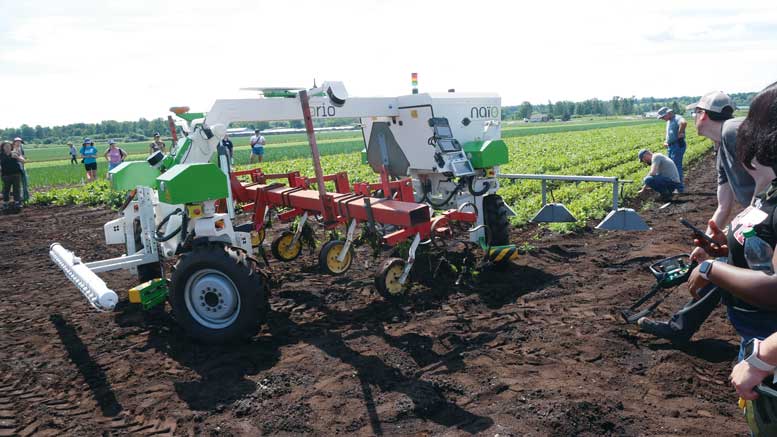
One emerging technology is the Naïo Orio, an autonomous tool-carrier robot from France designed to perform several field operations in vegetable crops (Fig. 1). Research at the University of Guelph evaluated the performance of the Orio in vegetable crops on different soil types in the Holland Marsh of Ontario, Canada, to determine how well it could perform typical weed management operations compared with a conventional tractor.
Naïo Orio
The Naïo Orio is designed to operate autonomously using GPS guidance and onboard sensors to ensure safe operation. The robot functions as a tool carrier, meaning that different implements can be attached depending on the operation required. The Orio was used for weed management in carrot on both high organic (muck) soils (organic matter 40-80%) and mineral soils (organic matter 2.4%).
The robot performed many of the same tasks as a tractor, including mechanical cultivation and herbicide application between crop rows. The Orio was also used for field preparation tasks such as mapping field boundaries, creating straight lines for seeding, and preparing beds. Mapping was conducted early in the season and required several hours to establish field boundaries and operational paths for both the robot and the tractor; however, once field layouts are stored, this step may not be required every year.
The Orio needs to be trailered between charging and the field, which adds time to the robot operations, but one person can supervise several robots once operating. A sprayer was designed and built by research station staff for use with the Orio. In Ontario carrot production, herbicides are typically applied in bands both over the crop row and between rows. The system was equipped with a Raven CR-7 field computer to control application parameters, including flow rate and field boundaries.
Field Trials in the Holland Marsh
Trials were conducted at four field sites. Two were located on high organic matter soils; two additional fields were located on nearby mineral soils. Carrots were grown on raised beds, and the robot’s performance was compared with conventional tractor operations carrying out the same weed management tasks. The robot performed inter‑row cultivation and herbicide application. The trials were randomized with long rows so the activities could be performed at speeds similar to conventional equipment for certain tasks. Cultivation was performed at 5 to 5.5 km/h, while spraying was conducted at 2 km/h.
Over the season, the robot accumulated 36 hours of active field work and 32 hours of downtime. Most downtime was associated with battery charging, mostly overnight, and troubleshooting issues with the GPS or sensor connections. Overall, slightly more than half of the robot’s total operational time was spent carrying out field activities, including mapping, cultivation and spraying.
-AMAZONPOLLY-ONLYWORDS-START-
-AMAZONPOLLY-ONLYWORDS-END-
Weed Management Results
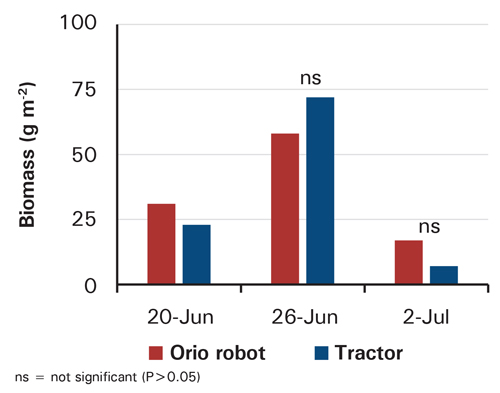
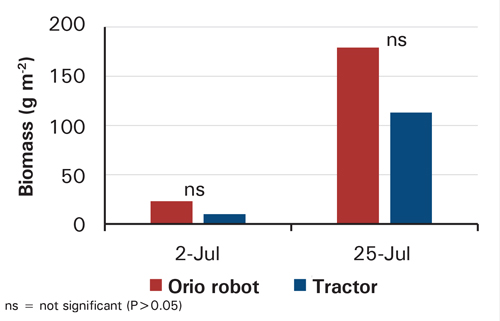
Weed control results varied depending on crop type and soil conditions. On muck soils, however, weed density and biomass declined over time in both robot and tractor treatments. By early July, weed pressure had dropped to low levels in both treatments, and the robot was able to provide comparable weed management later in the season. In mineral soil, weed density was generally similar between the two systems, although robot-treated plots sometimes had higher weed density (Fig. 2, Fig. 3).
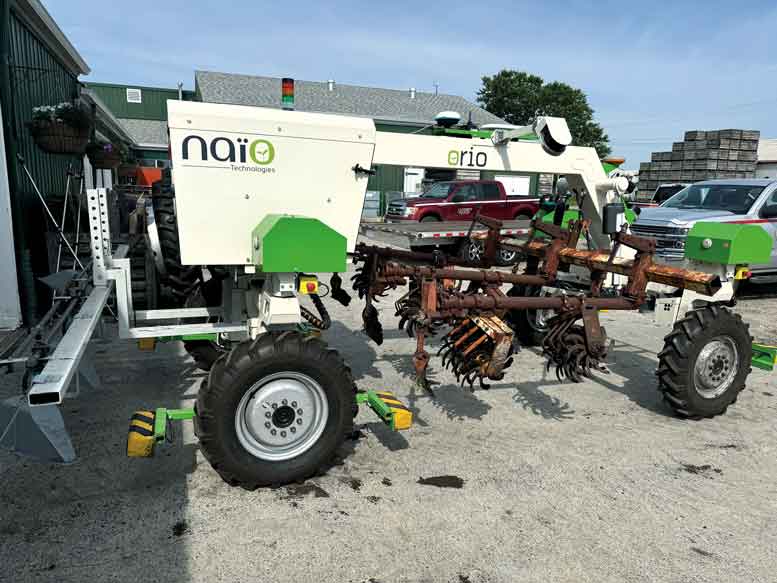
Several weeding cultivators were evaluated during the trials. An S-tine cultivator was initially used; however, it did not control weeds close to the crop row. The cultivator was replaced with a Lilliston-type rolling cultivator (Fig.4), which provided improved weed control closer to the crop. Field conditions and crop type may influence the effectiveness of different weed management strategies.
Yield Comparisons
Crop yields were also influenced by soil type. In carrots, yields were similar between robot and tractor treatments within the same soil type. Carrot yield was generally higher on muck soils compared with mineral soils regardless of the equipment used. The Orio had similar yields comparable to the conventional tractor.
Looking Ahead
Autonomous agricultural robots such as the Naïo Orio are still in the early stages of development. However, the trials demonstrate that these systems can successfully perform several important field operations. This was the first study to run side-by-side comparisons of the Orio and a tractor.
Challenges remain for robotic start-up companies, and the Orio is currently no longer in production by Naïo. Additional limitations include battery charging time and technical reliability. Despite ongoing issues, the continued improvements in software, mapping systems and hardware are expected to enhance the reliability and practicality of autonomous robots in the future. As these technologies advance, autonomous field robots could become valuable tools for vegetable growers by reducing labor requirements and improving precision and efficiency.By Kevin Vander Kooi, Geoff Farintosh, Ifesinachi Ezeh and Mary Ruth McDonald, University of Guelph
Agriculture is undergoing rapid change as new technologies are adopted to help farmers address labor shortages, increasing production costs and the demand for more precise crop management. Vegetable production, particularly carrots, involves frequent field operations such as cultivation, spraying and hand weeding, which are both time consuming and labor intensive. Interest in autonomous machinery has grown in recent years. Robotic field equipment has the potential to carry out routine tasks while maintaining a high level of precision and consistency. These technologies may enable growers to reduce labor needs, increase efficiency and apply crop inputs more accurately.
One emerging technology is the Naïo Orio, an autonomous tool-carrier robot from France designed to perform several field operations in vegetable crops (Fig. 1). Research at the University of Guelph evaluated the performance of the Orio in vegetable crops on different soil types in the Holland Marsh of Ontario, Canada, to determine how well it could perform typical weed management operations compared with a conventional tractor.
-AMAZONPOLLY-ONLYWORDS-START-
-AMAZONPOLLY-ONLYWORDS-END-
Naïo Orio
The Naïo Orio is designed to operate autonomously using GPS guidance and onboard sensors to ensure safe operation. The robot functions as a tool carrier, meaning that different implements can be attached depending on the operation required. The Orio was used for weed management in carrot on both high organic (muck) soils (organic matter 40-80%) and mineral soils (organic matter 2.4%).
The robot performed many of the same tasks as a tractor, including mechanical cultivation and herbicide application between crop rows. The Orio was also used for field preparation tasks such as mapping field boundaries, creating straight lines for seeding, and preparing beds. Mapping was conducted early in the season and required several hours to establish field boundaries and operational paths for both the robot and the tractor; however, once field layouts are stored, this step may not be required every year.
The Orio needs to be trailered between charging and the field, which adds time to the robot operations, but one person can supervise several robots once operating. A sprayer was designed and built by research station staff for use with the Orio. In Ontario carrot production, herbicides are typically applied in bands both over the crop row and between rows. The system was equipped with a Raven CR-7 field computer to control application parameters, including flow rate and field boundaries.
Field Trials in the Holland Marsh
Trials were conducted at four field sites. Two were located on high organic matter soils; two additional fields were located on nearby mineral soils. Carrots were grown on raised beds, and the robot’s performance was compared with conventional tractor operations carrying out the same weed management tasks. The robot performed inter‑row cultivation and herbicide application. The trials were randomized with long rows so the activities could be performed at speeds similar to conventional equipment for certain tasks. Cultivation was performed at 5 to 5.5 km/h, while spraying was conducted at 2 km/h.
Over the season, the robot accumulated 36 hours of active field work and 32 hours of downtime. Most downtime was associated with battery charging, mostly overnight, and troubleshooting issues with the GPS or sensor connections. Overall, slightly more than half of the robot’s total operational time was spent carrying out field activities, including mapping, cultivation and spraying.
Weed Management Results
Weed control results varied depending on crop type and soil conditions. On muck soils, however, weed density and biomass declined over time in both robot and tractor treatments. By early July, weed pressure had dropped to low levels in both treatments, and the robot was able to provide comparable weed management later in the season. In mineral soil, weed density was generally similar between the two systems, although robot-treated plots sometimes had higher weed density (Fig. 2, Fig. 3).
Several weeding cultivators were evaluated during the trials. An S-tine cultivator was initially used; however, it did not control weeds close to the crop row. The cultivator was replaced with a Lilliston-type rolling cultivator (Fig.4), which provided improved weed control closer to the crop. Field conditions and crop type may influence the effectiveness of different weed management strategies.
-AMAZONPOLLY-ONLYWORDS-START-
-AMAZONPOLLY-ONLYWORDS-END-
Yield Comparisons
Crop yields were also influenced by soil type. In carrots, yields were similar between robot and tractor treatments within the same soil type. Carrot yield was generally higher on muck soils compared with mineral soils regardless of the equipment used. The Orio had similar yields comparable to the conventional tractor.
Looking Ahead
Autonomous agricultural robots such as the Naïo Orio are still in the early stages of development. However, the trials demonstrate that these systems can successfully perform several important field operations. This was the first study to run side-by-side comparisons of the Orio and a tractor.
Challenges remain for robotic start-up companies, and the Orio is currently no longer in production by Naïo. Additional limitations include battery charging time and technical reliability. Despite ongoing issues, the continued improvements in software, mapping systems and hardware are expected to enhance the reliability and practicality of autonomous robots in the future. As these technologies advance, autonomous field robots could become valuable tools for vegetable growers by reducing labor requirements and improving precision and efficiency.