

By Tim Delbridge, Oregon State University
There are many state and federal regulations that agricultural producers must navigate to get a crop from the field to the market. Worker safety laws, pesticide application and recordkeeping rules, and environmental regulations all contribute to a complex regulatory environment for farms across the country. However, it is often the case that neither policymakers nor farmers have a clear understanding of how much it actually costs farms to comply with the regulations they face.
Over the past year, researchers at Oregon State University have published studies on the cost of regulatory compliance in the Oregon tree fruit industry and the impact of agricultural overtime laws on Oregon dairy, nursery and cherry producers. Here, we share with you the findings of these studies, as well as what lessons vegetable growers can learn from the results.
Regulatory Compliance Costs
Following similar studies focused on the lettuce industry in California’s Salinas Valley, we conducted a series of detailed interviews with cherry and pear producers in Oregon to identify their annual per-acre regulatory compliance costs. We included both cash expenses (for example, payroll costs associated with mandatory worker safety training) and non-cash costs such as the owner’s time spent on paperwork and other compliance steps.
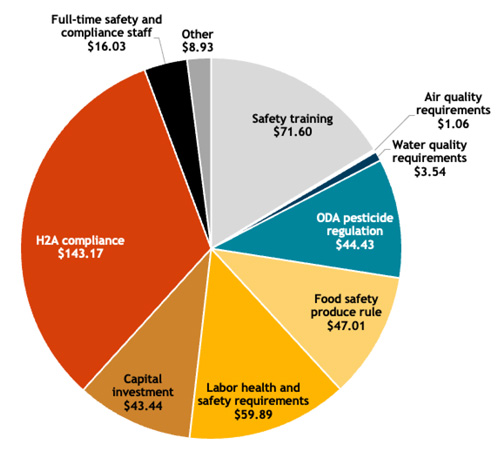
Total regulatory costs ranged from roughly $250 per acre for a 2,500-acre cherry operation to $700 per acre for a 50-acre pear grower. Labor-related regulations were the most costly set of policies, and include safety training, health-related requirements and H-2A rules. Pear growers tended to have higher per-acre costs, in part because of their greater reliance on the H-2A program. Larger farms tended to observe some economies of scale because they employed office staff that were focused on regulatory compliance, saving the time of other managers.
Agricultural Overtime
The phase-in of agricultural overtime in Oregon has been a topic of concern for many farms in the state. Starting on Jan. 1, 2023, farmworkers were entitled to 1.5x pay on hours above 55 in a week. This threshold dropped to 48 hours per week on Jan. 1, 2025, and will drop to 40 hours per week in 2027. This follows similar laws in California and Washington, which are now both fully phased in.
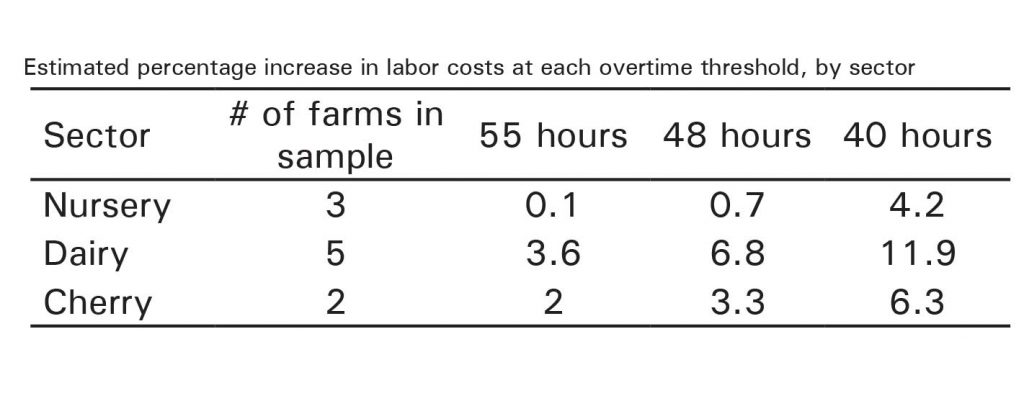
Our study used actual payroll data from 10 Oregon farms to estimate the increase in payroll costs that farms would face under each overtime threshold level. Data included the wage rate and number of hours worked by each employee in each week from 2022 to the end of 2024. These farms included dairy, nursery and tree-fruit producers. Results showed that if farmers didn’t reduce the hours that their employees worked, payroll costs under the 40-hour threshold would go up by 4% on nursery operations, 12% on dairies and 6% on the cherry farms included in the study. Given the small profit margins on most farms, an increase in payroll costs of this magnitude could have a much larger impact on net income.
We also explored the impact of the new overtime policy on individual workers. We found that some workers earned less in 2023 after the 55-hour overtime threshold was adopted than they earned in 2022 without the overtime law in place. In particular, one dairy farm had five full-time employees that averaged more than 55 hours of work in 2022. These workers all saw decreases in total income in 2023 because they worked fewer total hours. Some workers are likely to be better off with overtime pay, but many workers are likely to see hours and total wages fall, which matches research on ag overtime from other states and anecdotal evidence from farm owners and hourly workers in the Pacific Northwest.
-AMAZONPOLLY-ONLYWORDS-START-
-AMAZONPOLLY-ONLYWORDS-END-
Relevance for Vegetable Producers
These studies focus on the experience of tree fruit, nursery and dairy producers in Oregon. Their production systems and labor needs are obviously different than those of vegetable crop producers in other areas, but there are still some lessons to take away from these results. First, we’ve found that many growers are surprised by their own overtime costs and the amount of time and money spent on regulatory compliance once they are tallied up. In some cases, the growers have identified costly compliance steps that could be made more efficient without violating regulations. It is important for all producers to understand these components of their cost of production so that they may respond to policy changes as effectively as possible.
Another important theme that emerges from both regulatory compliance and ag overtime studies is that larger farms may have an advantage in navigating these headwinds. Either because of their greater operational flexibility or because many compliance steps take no more time for 1,000 acres than they do for 500, large farms may face smaller increases in production costs on a per-acre basis. If so, the additional pressure on smaller farms will contribute to the other consolidating forces that have reshaped the agricultural landscape over the past 80 years.
Author’s note: Please reach out to tim.delbridge@oregonstate.edu with questions or for links to the full publications.